01 /
Why only MiCA-licensed exchanges make this list
Until the summer of 2026, two kinds of platforms coexisted in Spain: those that already had a MiCA license and those still operating under the old Bank of Spain registration thanks to a transitional period. That period ended on June 30, 2026. Since July 1, only entities authorized by the CNMV, or by another European supervisor with a passport for Spain, can provide services to you, and since that date the same applies across the EU.
The CNMV put it in writing in its statement of June 15, 2026 (in Spanish): anyone who deals with an unauthorized entity “will not have the protection offered by the MiCA Regulation”. And ESMA, in its April 2026 statement, pointed out that this protection only covers the specific company authorized in the EU, not other companies in the same group or those based outside the EU.
What protection is that? Your crypto has to be legally segregated from the exchange's own assets, your euros have to end up in a separate bank account, you get a free complaints channel and someone supervises all of it. It isn't a guarantee fund: if the platform goes bust or the price collapses, nobody gives you your money back. But it's the difference between playing by the rules and playing without them. The fine print of the law is in the guide to MiCA regulation.
02 /
The filter: license, passport for Spain and real activity
To build this list I started from 14 well-known exchanges and required three things of each one, no exceptions:
- A current MiCA license held by the company that actually provides the service, checked in ESMA's interim register, whose entries were last updated on October 15, 2026.
- A passport notified for Spain, checked in the CNMV's list, which also shows the date from which each firm may provide MiCA services here.
- Real activity. A register can list licenses with nothing behind them: Gemini still shows up even though it left the European Economic Area in April 2026, and in May Austria's FMA was still barring KuCoin EU from starting operations; I haven't found anything saying that ban has been lifted.
14
exchanges analyzed
10
with a MiCA license, a passport and real activity in Spain
2
with no MiCA license: Binance and Bitget
2
licensed but not serving customers here: Gemini and KuCoin EU
With the ten survivors, I compared what matters to someone buying from Spain: the real cost of buying (fee plus spread), SEPA deposits, the record of hacks and sanctions, proof of reserves and a website in Spanish. That's where the order and the notes in the table come from.
03 /
The 10 MiCA-licensed exchanges you can use in Spain
This is the order I'd put them in with October 2026 data. It's an editorial opinion: at the top are the ones that combine a verified license, low costs for a retail buyer and the fewest drawbacks. If your priority is different, the next section helps you reorder the list. If you live elsewhere in the EU, the licenses are the same, but the passport dates in the table are Spain's: check your own country in ESMA's register, as I explain further down.
Two notes for reading the table. First, maker and taker are the fees on each exchange's order book market, the “advanced” or “Pro” screen; the quick-buy button almost always costs more, and I explain why further down. Second, the Spain date isn't the license date: OKX has held a license in Malta since January 2025, but according to the CNMV it has only been allowed to provide MiCA services here since November 27, 2025.
If you prefer video, in “Los 3 MEJORES Exchanges de criptomonedas en 2026” (the three best crypto exchanges of 2026; like all my videos, it's in Spanish) I narrowed it down to three and told you which one is the safest, which one suits you best if you're in Spain and which one has the lowest fees, with their pros and cons. This page widens the list to the ten that pass the filter, with October data.
Chapters (6)
04 /
My pick: OKX, downsides included
The exchange I use is OKX, and it's the one I put first. Not because it's perfect, but because, on these numbers, it strikes the best balance of what I ask of a platform:
- A license you can verify. OKX Europe Ltd, authorized by Malta's MFSA on January 27, 2025, with a passport for Spain since November 27, 2025.
- Reasonable fees from the first euro. 0.20% maker and 0.35% taker on the standard tier, below the first tier at Kraken, Coinbase or Bit2Me Pro.
- Euro deposits at no cost on its side. OKX doesn't charge for SEPA or SEPA Instant deposits, which arrive in seconds, at any hour, up to 100,000 euros.
- Monthly proof of reserves. According to its own page, it was on report number 48 in October 2026. It's a snapshot of its assets, not an audit, but for several exchanges in the table I couldn't find one at all.
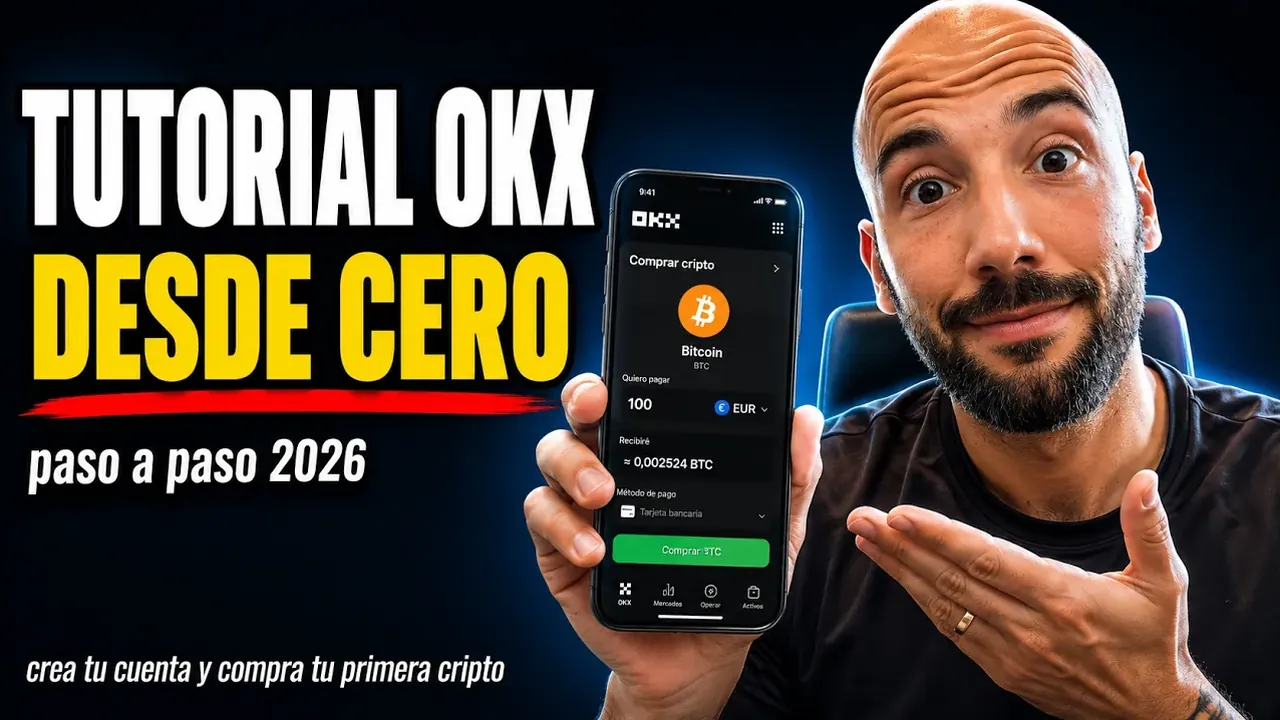
- A website in Spanish, branded “OKX Europa”, and a step-by-step tutorial I recorded, which you'll find just below.
Now the downsides, because they count too:
- Sanctions in 2025. In February, the company that runs OKX globally pleaded guilty in the United States to operating as an unlicensed money transmitter and agreed to pay more than $504 million. In April, Malta's anti-money-laundering unit (FIAU) fined OKCoin Europe 1,054,269 euros over failings found in 2023. And the Dutch central bank (DNB) fined it 2.25 million euros for operating without registration in the Netherlands between 2023 and 2024.
- The low rate comes with a catch. The 0.08% and 0.10% rates only apply if you open an X-Perps derivatives account, which requires passing an appropriateness test and gives you access to products with leverage of up to 10x. I wouldn't open a derivatives account to save a few cents on spot purchases.
- Lots of risky products in the app. Futures, bots, “earn” products... None of that is needed to buy bitcoin, and the derivatives don't come under the MiCA license but under another company in the group.
Full transparency: the OKX links on this site are affiliate links. If you open an account through them, the channel may earn a commission at no extra cost to you. OKX is the only exchange with an affiliate link on this site, and that's exactly why I'm telling you about its fines with names and figures. If you'd rather use another one after reading this, great: that's what the table is for. One more thing: the link takes you to OKX's European site, run by its EU entity, OKX Europe Ltd. If you live outside the European Economic Area, check which OKX entity would serve you in your country and under what license.
Chapters (9)
05 /
Which one to choose for your situation
There's no single best exchange for everyone. If OKX doesn't suit you, this is how I'd reorder the list depending on what matters most to you:
Whichever you choose, the mechanics of buying are the same: verify your identity, deposit by SEPA, buy with a limit order and withdraw to your wallet. I walk you through it step by step in how to buy bitcoin in Spain.
06 /
Binance and Bitget: why they're not on the list
Binance has no MiCA license in any EU country as of October 15, 2026. On June 24 it withdrew the application it had filed in Greece and, since July 1, it has stopped accepting new sign-ups, deposits and new spot trades in Spain, among other services. Withdrawals remain open, so if you have a balance there you can take it out. Its Spanish company has been marked as deregistered in the Bank of Spain's register since that same July 1.
According to an investigation published in August 2026, new accounts could still be opened from Spain. A website letting you sign up doesn't mean it's authorized: ESMA told unlicensed platforms to stop onboarding clients in the EU, and if one reels you in with advertising, it can't claim that you were the one who went looking for it.
Bitget has no MiCA license either. Its European subsidiary is waiting for authorization in Austria, but as of October 15 it appears neither in ESMA's register nor in the CNMV's list, and it was never registered with the Bank of Spain. It shut down its services in France on March 31, 2026 and, on September 24, suffered the theft of about $388 million from its hot wallets, which it says it's covering with its protection fund.
If you come from my older videos, you'll see links to Bitget in some descriptions. Today I don't recommend it for trading from Spain, and on this site you won't find links to Bitget or to Binance. The video I recorded on June 30, right before the change, explains what happened with Binance and what to do with your crypto.
Chapters (5)
07 /
How to check an exchange's license yourself
Don't trust this table or any other: the registers change every week. Checking takes five minutes.
- 01
Look up the company, not the brand
The terms and conditions or the website footer name the company that provides the service: OKX Europe Ltd, Bitcoinforme S.L., Payward Europe Solutions Ltd... That's the one you have to search for, not the name of the app.
- 02
Download ESMA's register
The interim register is on ESMA's MiCA page. The service providers (CASPs) file is a CSV that opens in any spreadsheet. Find the company and look at the supervisor, the authorization date and the services.
- 03
Check that Spain, or your country, is listed
In the same row there's a column with the codes of the countries where it may provide services. For Spain, ES has to be there. If it isn't, that license doesn't allow it to serve you here. If you live elsewhere in the EU, look for your own country's code instead.
- 04
Cross-check with the CNMV
The CNMV's list of providers (PDF, in Spanish) includes the firms authorized in Spain, marked “PSC (España)”, and those operating here under a passport, marked “PSC en régimen de LP” with their home country, along with the date from which they may provide MiCA services here.
- 05
Check the services
An entity may be authorized for custody but not to exchange crypto for euros, or the other way around. To buy with euros and keep your crypto there, you need at least exchange for funds or a trading platform, plus custody.
- 06
Rule out the blacklists
Search for the name in the CNMV's warnings search tool and in the non-compliant entities file of ESMA's own register. If it shows up in either one, there's nothing more to think about.
ESMA's register is updated every week and can lag a little, which is why the CNMV recommends checking both. If something doesn't add up, ask before you deposit a single euro: ask the platform, in writing, and ask the CNMV (or your own national supervisor if you live elsewhere in the EU).
08 /
What you really pay: spread versus maker and taker
Almost every exchange has two doors. The simple buy, the big “Buy” or “Convert” button, gives you a fixed price and that's it. The order book market, the “Pro” or “advanced” view, puts you up against other buyers and sellers, and that's where you pay the maker or taker fee: maker if your order waits in the book, taker if it fills instantly against one that was already there.
The first door usually has the cost built into the price, the spread, which is why it looks free. OKX explains this in its own help pages: its Convert doesn't show a fee line, but the quoted price includes a spread, and it advises you to compare it with the market price before you confirm. Other platforms charge a fee and a spread at the same time: Bit2Me calculates, in its official example, that a simple buy of 100 euros costs around 2.15%.
On the order book there's also a small gap between the best buy price and the best sell price, but on a pair as liquid as BTC/EUR it's usually tiny. On a one-off purchase, the difference in the table is the price of a dinner out. If you buy every month for years, it's a lot of money. My rule of thumb: when the amount matters, use the market and a limit order. I explain it calmly in the guide to how to buy bitcoin step by step.
09 /
After you buy: your crypto is better off in your own wallet
Buying on an exchange isn't the same as owning bitcoin. You have a balance in its system and it holds the keys. MiCA requires it to keep your crypto separate from its own assets, which helps if it goes bust, but you still depend on it not getting hacked, not freezing your account and nobody making a mistake.
Most people leave it on the platform where they bought it, not knowing they're making one of the mistakes that has lost people the most money in the history of crypto.
The sensible move: leave on the exchange whatever you're going to move soon and withdraw the rest to a wallet of your own. For serious amounts, a hardware wallet bought only from the official store: in October 2026, tampered Ledger devices sold by a reseller in Southeast Asia turned up. You'll find the comparison in the best cold wallets and everything else in the crypto security section.
A detail that surprises a lot of people: if you withdraw more than 1,000 euros to a wallet of your own, the exchange has to check that the address is yours. The EU regulation on transfers of crypto-assets has required it since December 30, 2024. It isn't distrust, it's the rule, and it doesn't stop you from taking your coins out.
10 /
Spanish taxes: what changes depending on where you keep your crypto
This part applies if you're a tax resident in Spain. Buying with euros isn't taxed. Selling is, and so is swapping one crypto for another, even if you never go through euros. The gain goes into the savings base of personal income tax (IRPF), at 19% to 30% depending on the bracket, and the tax agency applies the FIFO rule: the first coins you bought are the first ones considered sold.
What many people don't know is that the exchange's country matters. Almost all of the ones in the table hold your crypto from outside Spain: Malta, Ireland, Luxembourg, Austria, the Netherlands or Cyprus. If on December 31 you hold more than 50,000 euros in total with foreign custodians, you have to file Form 721 between January 1 and March 31. Bit2Me is Spanish, so whatever you hold there doesn't count toward Form 721, and neither does what you keep in your own wallet.
And the tax agency is going to know more and more. Under the DAC8 directive, since January 1, 2026, providers collect data on your transactions for the tax authorities, and the first exchange of information between countries is scheduled for September 30, 2027 at the latest. All the details, with examples, are in the guide to crypto taxes in Spain.