01 /
Both have suffered data leaks (and no, no seeds got out)
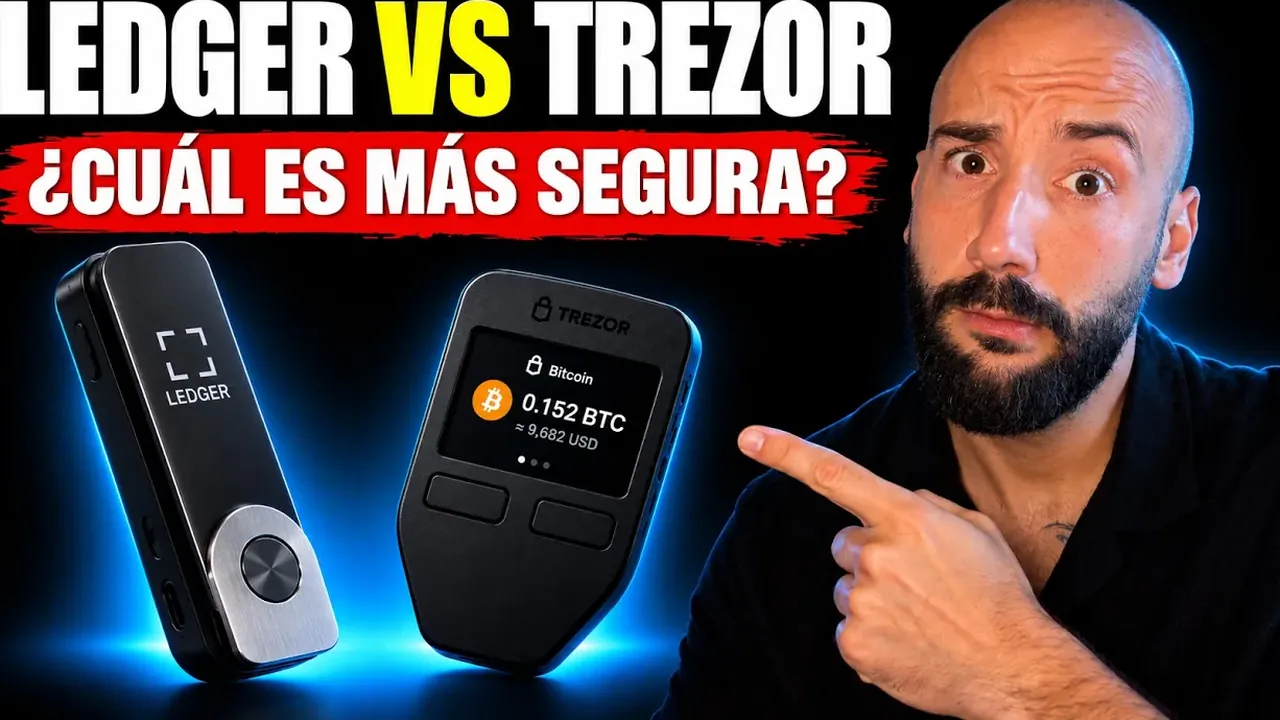
That's where the video starts, and it's not a bad place to begin. Ledger lost customer data in 2020 and in January 2026; Trezor, in 2024 and twice in 2026. In no case did seed phrases or private keys get out: what leaked were names, emails, phone numbers and addresses. That won't empty your wallet, but it makes you a phishing target for years, so it weighs in the decision.
In case you're new to this: a hardware wallet is a device that generates your keys and signs transactions internally, without the key ever touching your computer or your phone. Ledger and Trezor solve that problem with different philosophies, and almost all their differences come from there.
Chapters (7)
02 /
Head to head at the same price
Comparing the Stax with the Safe 3 makes no sense. The fair thing is to pit models at the same price against each other, and the current ranges pair up almost on their own. These are the official stores' prices in euros, checked on October 17, 2026, which is what matters if you live in Spain or elsewhere in the EU:
Read with a cool head: in the entry range there's no clear winner; in the middle, Trezor is cheaper and Ledger offers more connectivity; at the top, the two are even on features and the difference comes back to philosophy. What doesn't show up on the product page is this:
03 /
Two philosophies: closed chip versus open source
Ledger builds everything around a certified secure chip (EAL6+ across almost the whole range) that stores the seed and resists physical attacks. The price is that the system running inside that chip isn't public: its agreement with STMicroelectronics, the chip maker, prevents it from publishing the low-level code. The apps, the Ledger Wallet application and the developer kit are open. In short: a very tough safe with part of the lock closed to inspection.
Trezor was born the other way around, with everything open so that anyone can review the firmware and the design. Its historical weak point was physical. On January 31, 2020, Kraken Security Labs published that, with 15 minutes of access to the device, it could extract the encrypted seed from a Trezor One or a Model T through voltage glitching, an attack on the microcontroller they used, and that the PIN protecting it could be brute-forced with no effort. Its advice at the time: enable the BIP-39 passphrase and don't let anyone get their hands on the device.
Those models had no secure chip because the ones available required non-disclosure agreements, which clashed with Trezor's open philosophy. The Safe range closed that gap with an EAL6+ chip that doesn't require them, and the Safe 7 goes a step further with the TROPIC01, a secure chip designed to be auditable. Today the choice is no longer “physical security versus transparency” as it was in 2020, but the nuance is still there: with Ledger you trust a component you can't review; with Trezor, code you can review even though almost nobody does.
04 /
Ledger: the good and the bad
The good
- EAL6+ secure chip in the Nano S Plus, the Nano Gen5, the Flex and the Stax (EAL5+ in the Nano X), backed by its own attack team, Donjon, which publishes research on other manufacturers' devices.
- Compatibility: more than 500 coins in Ledger Wallet and thousands more by connecting it to wallets like MetaMask, Phantom or Rabby, which I compare in the best hot wallets of 2026.
- Bluetooth and NFC on the mid-range and high-end models so you can use them with your phone, and large E Ink touchscreens on the Nano Gen5, the Flex and the Stax, which help you read what you sign.
- Recovery Key: an NFC card with a secure chip that stores a PIN-protected backup and comes with the Flex, the Stax and the Nano Gen5.
- A store in euros and support in Spanish, handy if you live in Spain or elsewhere in the EU.
The bad
- Closed code at the heart of the system, because of the non-disclosure agreement with the chip maker.
- Ledger Recover (announced in May 2023): it showed that the firmware can take an encrypted copy of the seed out of the chip if the user authorizes it. It's optional and paid, but it broke a promise many people took as absolute.
- Data leaks: 272,853 customers published with their name, address and phone number in December 2020, and another breach of order data in January 2026, through Global-e.
- Connect Kit (December 2023): one of its libraries for DeFi websites was tampered with for about 40 minutes and took about $600,000 from people who signed blindly. The devices weren't affected and Ledger promised compensation.
- CryptoBilis implants (October 2026): devices from a reseller in Southeast Asia carrying a spy circuit that the Genuine Check doesn't detect. MediaMarktSaturn pulled Ledger devices from its stores as a precaution.
05 /
Trezor: the good and the bad
The good
- Truly open source: firmware and hardware design are published.
- A secure chip with no non-disclosure agreements in the Safe range and, in the Safe 7, a second, auditable secure chip, the TROPIC01. Trezor also presents it as ready for the quantum era.
- Bitcoin-only editions of the Safe 3, the Safe 5 and the Safe 7, for people who don't want a single line of code for other coins on their device.
- Flexible backups: the standard 20-word backup (SLIP-39), the classic 12 or 24 words (BIP-39) or a backup split into several parts, for example so that any two of three are enough, so you don't depend on a single piece of paper.
- Cheaper in the mid-range: the Safe 5 costs €129 versus €179 for the Nano Gen5.
- It leaves the factory without firmware: you install it yourself during setup and the device verifies that it's genuine.
The bad
- Leak after leak: 66,000 support contacts in January 2024; in August 2026, 80,689 customers exposed by ShipMonk, its shipping company (Spain isn't among the countries of the affected orders); and in September, about 347,000 email addresses that received phishing about a fake vulnerability after the Brevo breach.
- Bluetooth only on the Safe 7: the Safe 3 and the Safe 5 always need a cable.
- Physical attack on the Safe 3, disclosed in March 2025: Ledger's Donjon team manipulated its microcontroller with the device in hand. It didn't extract the PIN or the keys from the secure chip and Trezor considers it largely theoretical, but it reinforces the rule of buying direct and verifying the firmware.
- Phishing from its own sender address (June 2025): attackers abused its support form so that fake emails arrived from help@trezor.io. There was no breach of its systems and the phishing domain was taken down, but it shows that not even the official sender is a guarantee.
06 /
A timeline of scares, with dates
The table leaves a clear conclusion: the real risk for you isn't in the chips but in everything around the device, from the store where you buy it to the email that arrives months later. Both brands tell you the same thing: neither will ever ask for your seed phrase. If someone asks for it, it's a scam, and you'll find the signs to recognize it in my guide to crypto scams.
07 /
Ledger Recover: the controversy that hasn't gone away
It deserves its own section because it's what weighs most for many people. Ledger Recover is a subscription service that encrypts your seed, splits it into three fragments and spreads them among Ledger, Coincover and EscrowTech; to recover it you have to identify yourself with an official ID. For someone afraid of losing the paper, it's a lifeline. For someone who bought a Ledger because the seed “never leaves the chip,” it was a bucket of cold water: technically, the firmware can export it encrypted if you give permission.
My reading: if you don't sign up, it isn't activated, and the physical alternative, the Recovery Key, doesn't depend on third parties. But if it bothers you to have to trust the company on that point, Trezor answers the same problem with backups split into several parts that you keep yourself, with no companies or ID documents involved.
08 /
If you only care about bitcoin
Here Trezor wins by a nose: it sells Bitcoin-only editions of the Safe 3, the Safe 5 and the Safe 7, with firmware that includes nothing else. Less code means a smaller attack surface and fewer updates that don't concern you. Ledger doesn't sell an edition like that: the device is the same for everyone and you decide which apps to install, even if it's only the Bitcoin one.
Beyond these two, the BitBox02 also has a Bitcoin-only edition and Coldcard is Bitcoin-only by design, although after its 2026 entropy flaw I'd reserve it for advanced users. You have them all compared, with prices and drawbacks, in the best cold wallets of 2026.
Chapters (6)
09 /
Which one to choose for your situation
Whichever one you buy, there are two rules worth more than any chip, and I put them in writing in the video description:
Never buy a second-hand wallet. Neither Ledger nor Trezor will ever ask you for your seed phrase.
Buy them only from their official stores. After the October 2026 implants, Trezor is going to cut back its reseller network on January 1, 2027, and MediaMarktSaturn pulled Ledger devices as a precaution. If you settle on one, here are the two official stores:
My verdict: for most people, Ledger, for compatibility and convenience; for those who put transparency first or only want bitcoin, Trezor. Both are far better than leaving everything on an exchange, and both fail the same way if you write your seed down on your phone. If you're still not sure whether you need a cold wallet, start with hot vs cold wallet, and to protect everything else, there's the security section. For your first purchase and your first transfer to the wallet, follow how to buy bitcoin.
This is NOT financial advice. It's my personal analysis. Always do your own research.
Keep learning